
Fixing DTC issues

As mentioned in a previous post, we were encountering issues when using the Distributed Transaction Coordinator.

By using the DTCTester tool we were able to prove that the problem was indeed related to the DTC settings and not a bug in our code(as if that could happen Winking smile).

Executed: dtctester
DSN:  test
User Name: username
Password: password
tablename= #dtc26446
Creating Temp Table for Testing: #dtc26446
Warning: No Columns in Result Set From Executing: 'create table #dtc26446 (ival int)'
Initializing DTC
DtcGetTransactionManager failed: 8004d01b
DtcGetTransactionManager Call Error: Indicates unable to connect to the transaction manager, or the transaction manager is unavailable.

We were able to solve the issue by adding an exception for msdtc.exe in our firewall:

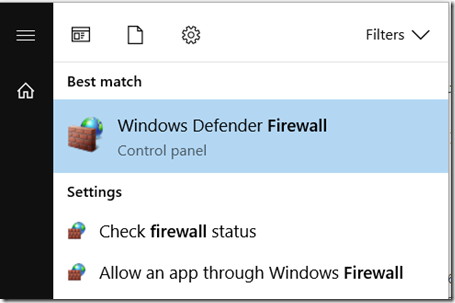
  • Click on the Windows icon and start typing ‘firewall’. Choose ‘Allow an app through Windows Firewall’.
image

  • The Allowed Apps window is loaded. Click on Change Settings. The Allow another app… button becomes enabled.

image

  • Click on the Allow another app… button and choose Browse… to select an application.

image

  • Search for MSDTC.exe and click on Open.

image

  • Click on Add to close the wizard.

image

  • Let’s try the DTCTester again to see if it works now:

Executed: dtctester
DSN:  test
User Name: username
Password: password
tablename= #dtc27076
Creating Temp Table for Testing: #dtc27076
Warning: No Columns in Result Set From Executing: 'create table #dtc27076 (ival int)'
Initializing DTC
Beginning DTC Transaction
Enlisting Connection in Transaction
Executing SQL Statement in DTC Transaction
Inserting into Temp...insert into #dtc27076 values (1)
Warning: No Columns in Result Set From Executing: 'insert into #dtc27076 values (1) '
Verifying Insert into Temp...select * from #dtc27076 (should be 1): 1
Press enter to commit transaction.

Commiting DTC Transaction
Releasing DTC Interface Pointers
Successfully Released pTransaction Pointer.
Disconnecting from Database and Cleaning up Handles

  • Fixed!

Popular posts from this blog

Podman– Command execution failed with exit code 125

After updating WSL on one of the developer machines, Podman failed to work. When we took a look through Podman Desktop, we noticed that Podman had stopped running and returned the following error message: Error: Command execution failed with exit code 125 Here are the steps we tried to fix the issue: We started by running podman info to get some extra details on what could be wrong: >podman info OS: windows/amd64 provider: wsl version: 5.3.1 Cannot connect to Podman. Please verify your connection to the Linux system using `podman system connection list`, or try `podman machine init` and `podman machine start` to manage a new Linux VM Error: unable to connect to Podman socket: failed to connect: dial tcp 127.0.0.1:2655: connectex: No connection could be made because the target machine actively refused it. That makes sense as the podman VM was not running. Let’s check the VM: >podman machine list NAME         ...

Cache stampede: when our cache turned against us

While investigating some performance issues, we ran into an ASP.NET Core API that cached a fairly expensive aggregation query for 60 seconds. Under normal load, that was fine: one request rebuilds the cache, everyone else reads from it. Under peak load, dozens of requests would arrive in that same expiry window, all see a cache miss, and all fire the same expensive query in parallel. The database didn't like that. That was the moment when our caching layer stopped helping and started hurting. A burst of requests comes in at the same time, all miss the cache, and all go hammer the database or the downstream API at once. That's a cache stampede . The cache was supposed to protect our backend, and for a few hundred milliseconds it did the opposite. Why this happens IMemoryCache.GetOrCreate (and its async sibling) looks like it protects you, but it doesn't add any locking on its own. Look at the naive version: public async Task<Report> GetReportAsync(string key) ...

A complex system designed from scratch never works

A few years ago, I worked as an architect on a big mainframe rewrite. I still count it as one of my failures. Not because the technology was wrong, but because I couldn't convince the management team to simplify the approach. Years later, the organization is still struggling to get the new system up and running. I left the project at the time, because I couldn't put my name behind an approach that would take very long and cost a lot of money without a working system to show for it along the way. Gall’s Law That memory keeps coming back to me, because it's a textbook case of Gall's Law playing out in real life. Gall's Law , from John Gall's Systemantics , states it plainly: A complex system that works is invariably found to have evolved from a simple system that worked. A complex system designed from scratch never works, and it cannot be patched to make it work. You have to start over with a simple system that works. What does that mean in practice,...